
According to the latest Gallup polling, more Americans choose real estate than stocks, gold, savings accounts, bonds, or cryptocurrency as the best investment for the long term. However, whether buying real estate is the right decision for you, especially in the St. Petersburg and Tampa Bay market, depends on your goals, timeline, finances, and the specific property.
Every year, Gallup asks Americans a straightforward question:
What is the best long-term investment?
In 2026, real estate reportedly earned the top spot again, continuing a long-running trend of Americans viewing property ownership as an effective way to build wealth over time.
That does not mean real estate automatically outperforms every other investment. It does show that, through changing interest rates, economic uncertainty, stock-market volatility, and shifting buyer sentiment, Americans continue to place significant confidence in owning property.
What Did Americans Choose as the Best Long-Term Investment in 2026?
According to reporting based on Gallup’s 2026 poll, Americans answered:
- Real estate: 38%
- Stocks or mutual funds: 20%
- Gold: 18%
- Savings accounts or CDs: 12%
- Bonds: 4%
- Cryptocurrency: 2%
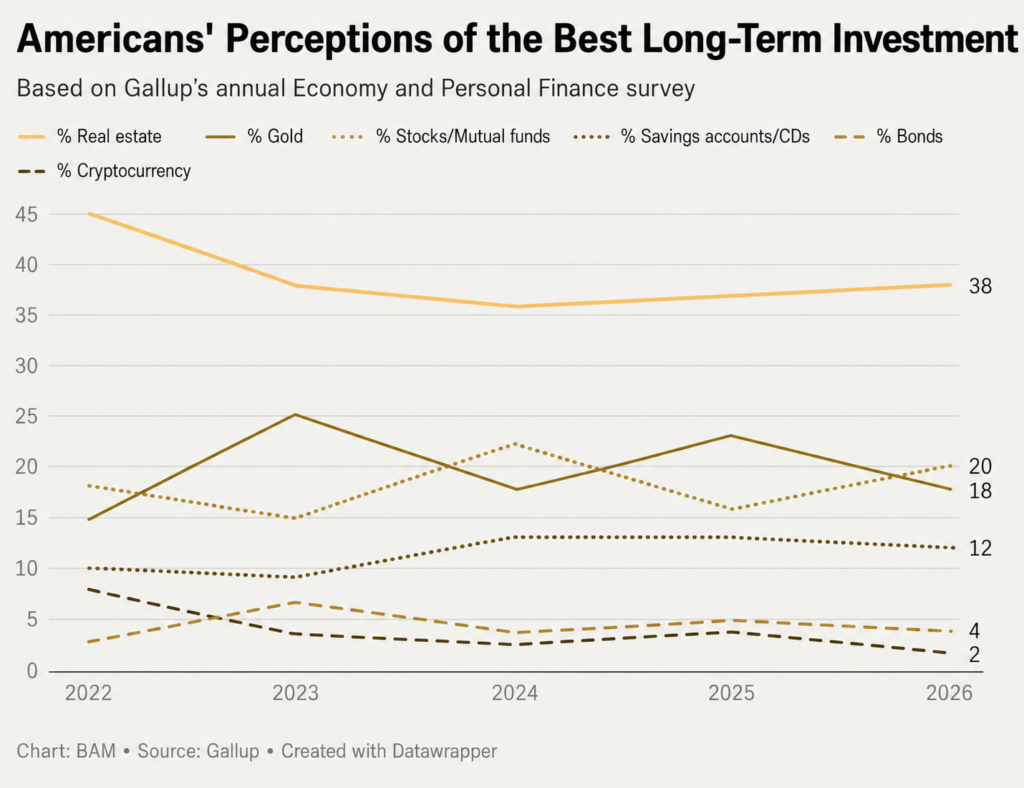
Americans’ choices for the best long-term investment in 2026. Source: Gallup.
Real estate’s share is nearly twice that of stocks and mutual funds, the next-highest response.
Stocks gained support compared with the previous year, while enthusiasm for gold moderated. Cryptocurrency continues to receive considerable attention online, but only a small percentage of Americans selected it as the best investment for the long term.
The central takeaway is not that other investments lack value. It is that real estate continues to occupy a distinctive place in how Americans think about long-term financial stability and wealth building.
How Long Has Real Estate Ranked First?
Gallup’s historical polling shows that real estate has remained at or near the top of Americans’ long-term investment preferences for more than a decade.
That period includes:
- A global pandemic
- Rapid home-price appreciation
- Rising mortgage rates
- Inflation concerns
- Stock-market fluctuations
- Significant changes in housing affordability
Real estate did not always hold the lead.
During the Great Financial Crisis, savings accounts and certificates of deposit briefly became more appealing as Americans looked for stability. Gold also moved ahead during the early 2010s, when many people were still concerned about the housing crash and broader economy.
Real estate subsequently returned to the top position and has remained Americans’ leading choice in recent Gallup surveys. Gallup’s 2025 report found that 37% of Americans selected real estate, compared with 23% for gold and 16% for stocks or mutual funds.
Why Is Real Estate Considered a Good Long-Term Investment?
Real estate can provide several potential financial and practical benefits that differ from those offered by stocks, bonds, or cryptocurrency.
You Own a Tangible Asset
A home is something you can see, use, improve, rent, or sell. Unlike an investment represented only by an account balance, residential real estate can also provide a place to live.
That combination of financial utility and everyday usefulness helps explain its lasting appeal.
You May Build Equity Over Time
When you make mortgage payments, a portion may reduce your loan balance and increase your ownership stake in the property. If the home appreciates, your equity may grow further.
Equity is not guaranteed, and home values can decline. However, owners who purchase carefully and hold their property over a longer period may be better positioned to benefit from changing market cycles.
Real Estate May Help Diversify Your Assets
Some buyers use real estate as one part of a broader financial plan that may also include retirement accounts, stocks, bonds, cash reserves, or business ownership.
Diversification does not eliminate risk, but it can reduce your dependence on the performance of a single type of asset.
You Can Improve the Property’s Value
Homeowners may have opportunities to influence a property’s condition, functionality, and marketability through maintenance and well-planned improvements.
That is different from owning shares in a company, where you generally have little control over the asset’s underlying performance.
Does Real Estate Always Outperform the Stock Market?
No. Real estate should not be presented as an investment that always produces higher returns than stocks.
Over certain historical periods, broad stock-market indexes have delivered stronger percentage returns than national home-price indexes. Stocks also tend to be more liquid because they can usually be bought or sold much faster than a property.
Real estate, however, offers benefits that a stock portfolio does not provide, including housing utility, potential rental income, the ability to use financing, and opportunities to add value through improvements.
The better comparison is not simply, “Which investment has risen more?”
A more useful question is:
Which investment is appropriate for your goals, risk tolerance, cash flow, timeline, and need for flexibility?
What Does Long-Term Home-Price Growth Show?
National housing data demonstrates why a longer ownership timeline matters. Home prices do not rise evenly every year, and individual markets can perform very differently from national averages.
The historical chart supplied with this article shows the following cumulative U.S. home-price changes:
- 1990s: +30.1%
- 2000s: +47.3%
- 2010s: +44.7%
- 2020–2024: +47.1%
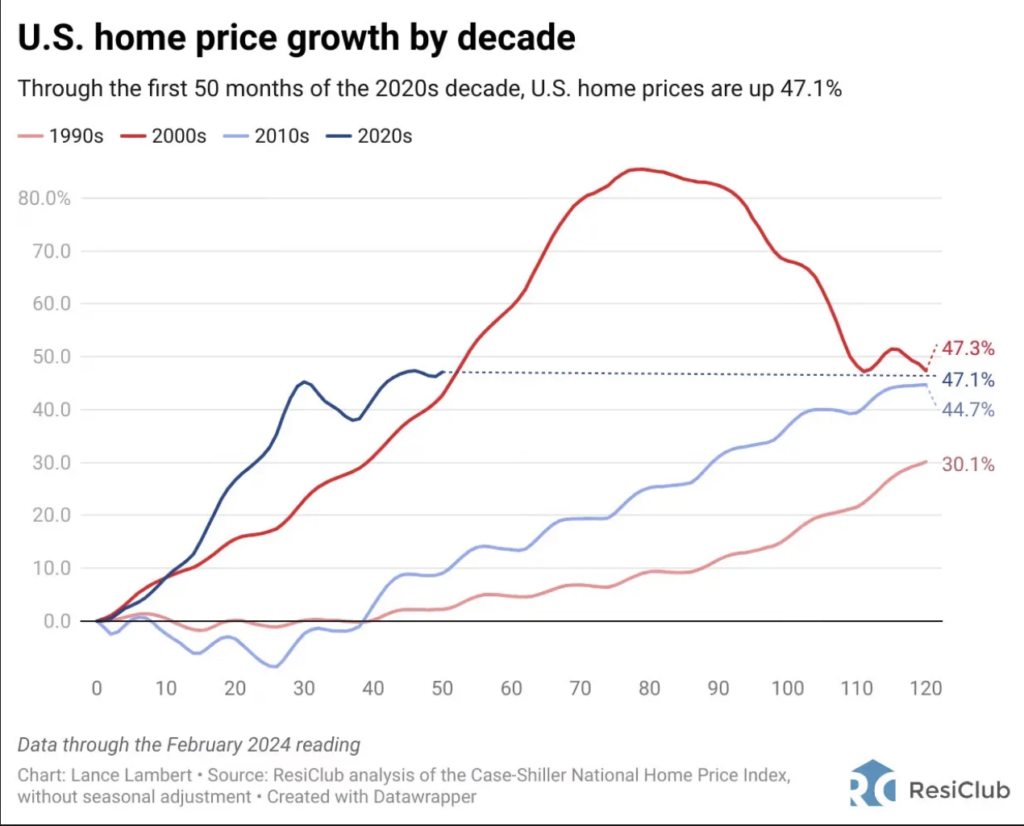
Cumulative U.S. home-price growth by decade. Source: ResiClub analysis of the Case-Shiller National Home Price Index.
These figures illustrate the potential benefit of holding real estate through multiple market cycles. They should not be interpreted as a promise that every property or local market will appreciate at the same rate.
Location, purchase price, property condition, insurance expenses, taxes, maintenance costs, financing, and the length of ownership all affect the final outcome.
Is St. Petersburg Real Estate a Good Long-Term Investment?
St. Petersburg real estate should be evaluated property by property rather than through national headlines alone.
The Tampa Bay housing market is made up of distinct neighborhoods and property types. A single-family home in Northeast St. Petersburg, a downtown condominium, a bungalow, and a waterfront property can have very different ownership costs, resale considerations, insurance requirements, and potential buyer pools.
Florida condominium buyers should pay particular attention to association finances, reserve requirements, assessments, building age, inspections, insurance, and monthly fees. These considerations can materially affect both affordability and long-term resale value.
For anyone considering buying a home in St. Pete, the strongest approach is to examine:
- How long you expect to own the property
- The full monthly cost, not only the mortgage payment
- Insurance, taxes, maintenance, and association expenses
- The property’s condition and future repair needs
- Recent comparable sales in the immediate area
- Your plans for the home, including personal use or rental use
- How the purchase fits into your broader financial strategy
National trends can provide context, but local property details determine whether a particular opportunity makes sense.
How Long Should You Own a Home for It To Be a Good Investment?
There is no universal minimum ownership period, but real estate is generally better suited to a longer timeline.
Buying and selling a home involves expenses such as closing costs, financing charges, inspections, repairs, moving expenses, and real estate transaction costs. If you expect to relocate within only a few years, those costs may limit or eliminate your potential financial gain.
A longer ownership period gives you more time to build equity and move through short-term market changes. Your break-even point will depend on the price you pay, financing terms, ownership costs, future sale price, and market conditions.
Frequently Asked Questions About Real Estate as a Long-Term Investment
Is real estate the number-one long-term investment in 2026?
Real estate received the largest share of responses in reporting based on Gallup’s 2026 survey. That result measures Americans’ opinions, not a guarantee that real estate will produce the highest return for every investor.
Is buying a home in St. Petersburg, Florida, a good investment?
It can be, depending on the property, purchase price, ownership costs, location, condition, and your expected timeline. A detailed local market and property analysis is more useful than relying solely on national forecasts.
Is real estate safer than stocks?
Neither investment is risk-free. Stocks can experience rapid price swings, while real estate carries risks related to market changes, financing, repairs, insurance, taxes, vacancies, and limited liquidity.
Can a primary residence help you build wealth?
A primary residence may help you build equity as you repay your mortgage and if the property appreciates. The financial result depends on your total ownership costs and eventual sale proceeds.
Should you buy real estate only because Gallup ranked it first?
No. A public-opinion survey can reveal how Americans view an investment, but it should not replace personalized financial advice, careful market research, or property-level due diligence.
The Final Takeaway
Real estate remains one of America’s most trusted long-term investments in 2026, but the right purchase requires more than following a national ranking.
The strongest real estate decisions are based on a realistic timeline, manageable ownership costs, careful property selection, and a clear understanding of the local market. In St. Petersburg and throughout Tampa Bay, neighborhood-level pricing, property condition, insurance considerations, and future resale potential can matter as much as national home-price trends.
When you are ready to explore whether buying or selling real estate fits your long-term plans, Sarah Schneider, St. Petersburg Real Estate Agent, can help you interpret the local market and make a confident, informed decision. Sarah provides attentive, knowledgeable real estate services for buyers and sellers throughout St. Petersburg and the greater Tampa Bay area, from evaluating individual properties to developing a strategy around your timing and goals.
Talk With Sarah About Your St. Pete Real Estate Goals
Considering buying, selling, or investing in St. Petersburg real estate?
Contact Sarah Schneider, St. Petersburg Realtor, for personalized guidance, local market insight, and exceptional real estate service designed around your goals. Whether you are comparing neighborhoods, evaluating a property’s long-term potential, or preparing your home for sale, you will have a trusted local resource helping you understand your options, determine your next step, and advocating on your behalf.
Real estate decisions should be made in consultation with qualified financial, tax, insurance, and legal professionals when appropriate. Past market performance does not guarantee future appreciation or investment returns.
—